Filling practice
Practice in 5 variations
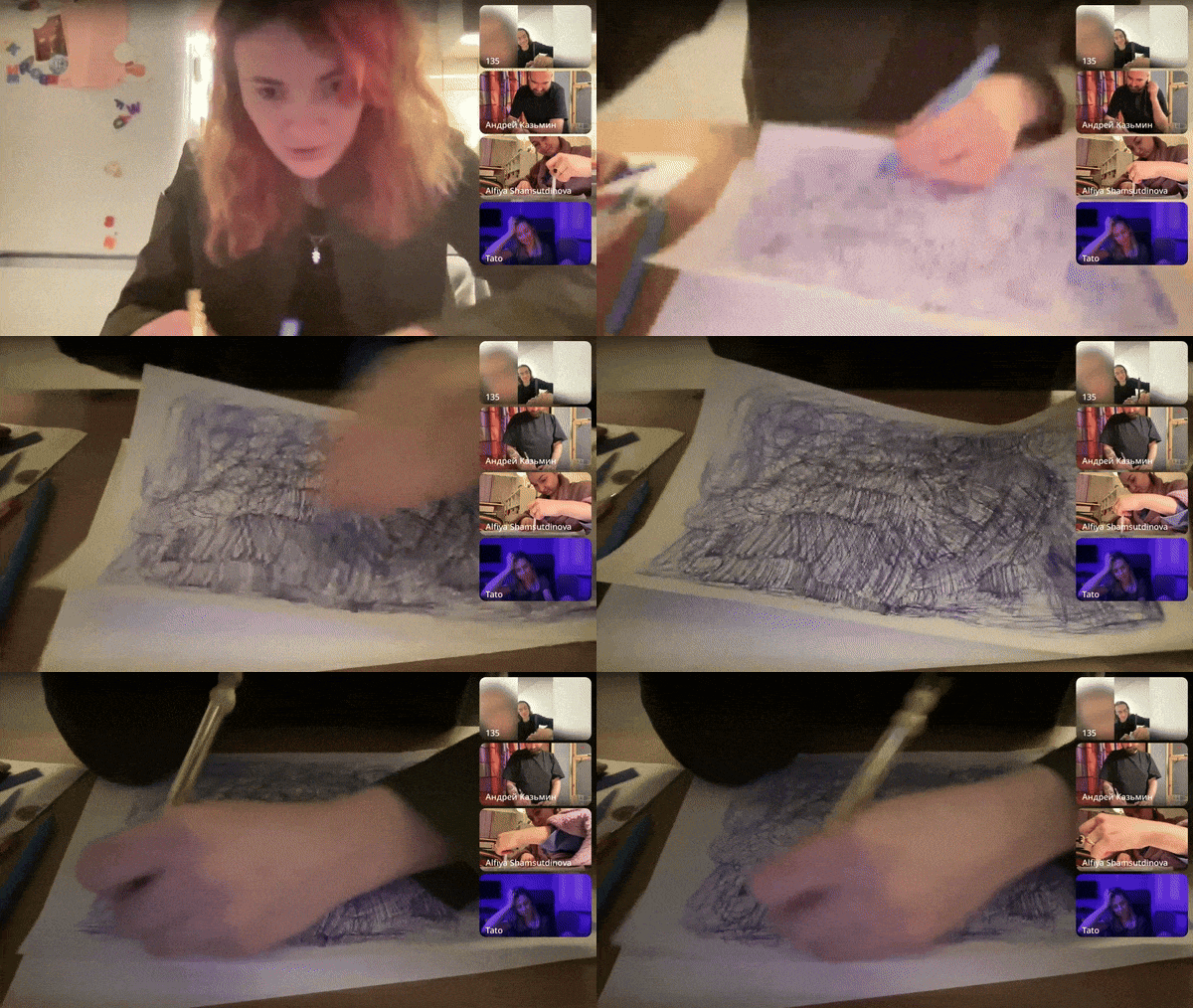
- Basic practice
- Sound co-tuning version
- Musical version of sound co-tuning version
- Postmedial version
- Anti version
1. Basic filling practise
synchronous, online, open
The participant needs to fill a piece of paper with lines. The main criterion for successful perfoming is the inability to distinguish the contour of a recognizable object or pattern within the filled area. The boundaries of the filled area must be read unmistakable.
Setting up
To perform the practice, the participant needs to prepare a sheet of white A4 paper and a pen with blue or black ink.
Note. You can perform the practice with other materials - the main thing is that the criteria for successful completion are met. The use of alternative means and the timing of such practice are agreed upon by the participants in advance.
Filling
Participants mark the time and begin painting.
About filling technique:
- avoid recognizable shapes and patterns;
- comfort is an important component of practice. The tempo, posture, and nature of the lines are determined by the participant himself and can change as the practice progresses;
- the filled area should be the most of the sheet and its boundaries should not coincide with the edges of the sheet;
- the boundaries of the filling zone are determined by the participant and held in the mind without any material tools to mark them.
The filling process can become automatic. Extraneous thoughts and the search for a comfortable position are a normal process that should not be resisted. The participant may get distracted and not look at the sheet for some time while perfoming - the main thing is not to forget about practice.
Ending
When the practice time has come to an end, the participant needs to make sure that the image on the sheet meets the formal criteria for successful completion - the border of the filled area can be guessed unmistakably (even if it is broken somewhere), and everything visible within its boundaries has no plot and clearly distinguishable outlines of recognizable objects.
The completeness of the sheet is determined by the participant and may depend on subjective feelings. If any criterion seems to be insufficiently fulfilled by the participant, additional time can be taken.
In the margins of the completed sheet, the participant signs the date, place of his stay (country or city) and indicates authorship (initials, signature or any other method).
Discussing phase
The discussion phase involves a general review of the resulting sheets by the practice participants. To do this, participants need to digitize the resulting sheet in any convenient way and share it with the practice moderator who organizes the joint viewing.
The discussion phase has two goals:
- Detect and formulate differences and similarities in the sheets obtained by the participants.
- Exchange impressions of the practice experience and try to compare it with the result image.
Practice documentation 26.01.23
2. Sound co-tuning
synchronous, online, open
The participant needs to extract the sound using the tools of the filling practice and try to find harmony with the sounds of other practitioners.
This variation of the practice invites participants to explore of one of the possible non-verbal collaboration on the Internet and puts focus on the perfoming process. However, following the formal criteria of the basic instruction may be useful for a deeper experience.
Setting up
To perform the practice, the participant needs to prepare a sheet of white A4 paper and any writing tool. Make sure your microphone is working and your equipment is ready for the online conference.
Note. The sound depends not only on the selected sheet and pen, but also on the surface on which the painting takes place. Before performing, it is recommended to experiment with various handy methods of sound production for greater variability during practice.
Sound check
It is recommended to spend the first 10 minutes of practice checking the equipment and setting up the software
Note. Sometimes it's useful to turn off automatic background noise suppression so that the sound of your painting doesn't become distorted. In the zoom settings, this can be done in the “Sound Profile” menu in the “Sound” tab.
Filling
Participants mark the time and begin painting. Try to concentrate on the noise sound of your painting, and then on the sounds of other participants. Your task is to try to use these sounds to find a way to interact with each other without resorting to verbal and text communication.
About filling technique:
- avoid recognizable shapes and patterns;
- comfort is an important component of practice. The tempo, posture, and nature of the lines are determined by the participant himself and can change as the practice progresses;
- the filled area should be the most of the sheet and its boundaries should not coincide with the edges of the sheet;
- the boundaries of the filling zone are determined by the participant and held in the mind without any material tools to mark them.
The list above is advisory and can be partially or completely ignored in favor of achieving new communicative experience within the framework of the instructions.
Ending
When the practice time has come to an end, the participant needs to evaluate the resulting image on the sheet. The completeness of the sheet is determined by the participant and may depend on subjective feelings.
If the paricipant would like to try other versions of the filling practice, it is recommended to follow formal criteria of the basic version - this will allow the resulting sheets to be compared on a deeper level.
The formal criteria for successful completion:
- the border of the filled area can be guessed unmistakably (even if it is broken somewhere),
- everything visible within its boundaries has no plot and clearly distinguishable outlines of recognizable objects.
If any criterion seems to be insufficiently fulfilled by the participant, additional time can be taken.
In the margins of the completed sheet, the participant signs the date, place of his stay (country or city) and indicates authorship (initials, signature or any other method).
Discussing phase
The discussion phase involves a general review of the resulting sheets by the practice participants. To do this, participants need to digitize the resulting sheet in any convenient way and share it with the practice moderator who organizes the joint viewing.
The discussion phase has two goals:
- Detect and formulate differences and similarities in the sheets obtained by the participants.
- Exchange impressions of the practice experience and try to compare it with the result image.
Practice documentation 26.02.23
3. Musical variation of sound co-tuning version
synchronous, online, open
The participant will take part in a musical jam session in which the sound extracting only with the tools of the filling practice.
This instruction is an musical variation of the sound co-tuning version. The musical nature of sound co-tuning is given by the desire for compositional integrity, therefore the result of such practice is not only the painted sheets of the participants, but also a music album.
Note. Variations – the third generation from the basic version of the practice. It is recommended to perfom basic or one of the versions before trying the variation on.
Setting up
To perform the practice, the participant needs to prepare a sheet of white A4 paper and any writing tool. Make sure your microphone is working and your equipment is ready for the online conference.
Note. The sound depends not only on the selected sheet and pen, but also on the surface on which the painting takes place. Before performing, it is recommended to experiment with various handy methods of sound production for greater variability during practice.
Sound check
It is recommended to spend the first 10 minutes of practice checking the equipment and setting up the software
Note. Sometimes it's useful to turn off automatic background noise suppression so that the sound of your painting doesn't become distorted. In the zoom settings, this can be done in the “Sound Profile” menu in the “Sound” tab.
Music album
An album implies a set of tracks that will be cut from the recording of the practice, named and uploaded as separate audio files to suitable services.
It is recommended that before starting practice, agree on the approximate duration of the tracks or a conditional signal that would determine the beginning and end of the track.
During practice participant will have to choose the title, mood and length of the tracks and the entire album.
Recording
Participants mark the time and begin filling. Try to use tools and scribbling noise to find one or more rhythmic patterns. Try to find harmony with the drawings of other participants.
About filling technique:
- avoid recognizable shapes and patterns;
- comfort is an important component of practice. The tempo, posture, and nature of the lines are determined by the participant himself and can change as the practice progresses;
- the filled area should be the most of the sheet and its boundaries should not coincide with the edges of the sheet;
- the boundaries of the filling zone are determined by the participant and held in the mind without any material tools to mark them.
The list above is advisory and can be partially or completely ignored in favor of achieving new communicative experience within the framework of the instructions.
Ending
When the practice time has come to an end, the participant needs to evaluate the resulting image on the sheet. The completeness of the sheet is determined by the participant and may depend on subjective feelings.
If the paricipant would like to try other versions of the filling practice, it is recommended to follow formal criteria of the basic version - this will allow the resulting sheets to be compared on a deeper level.
The formal criteria for successful completion:
- the border of the filled area can be guessed unmistakably (even if it is broken somewhere),
- everything visible within its boundaries has no plot and clearly distinguishable outlines of recognizable objects.
If any criterion seems to be insufficiently fulfilled by the participant, additional time can be taken.
In the margins of the completed sheet, the participant signs the date, place of his stay (country or city) and indicates authorship (initials, signature or any other method).
Discussing phase
The discussion phase involves a general review of the resulting sheets by the practice participants. To do this, participants need to digitize the resulting sheet in any convenient way and share it with the practice moderator who organizes the joint viewing.
The discussion phase has two goals:
- Detect and formulate differences and similarities in the sheets obtained by the participants.
- Exchange impressions of the practice experience and try to compare it with the result image.
Practice documentation 26.03.23
Visual result of practice from 26.03.23
Audio result (single!) of practice from 26.03.23
4. Postmedial version
asynchronous, online, open
The participant needs to fill a certain period of time or space in such a way that the fact of filling will be indisputable and the method of filling will be homogeneous and manifested at the material level.
This version of the filling practice aims to take the experience of graphic drawing beyond it's medium and create a situation where participants could relate a variety of bodily experiences to one theoretical denominator.
Phases of the postmedial version of practice
- Сycle organization
- Filling
- Report
- Discussion
1. Cycle organization
Having agreed to conduct the post-medial version of the practice, the participants designate the start day. From this day the week is counted and the end day is fixed - the resulting period represents a cycle of practice.
By the start day, it is recommended to fix the number of participants in any convenient way and not expand it until the end of the cycle. Organizational predictability of the cycle is intended to ensure a focus on the perfoming experience during the report phase at the end of the cycle.
Note. The period between the start and end days may be different based on the results of joint discussion.
2. Filling
During the cycle period, the participant will have to discover his own method of filling in time and space.
Two important criteria – distinct physicality and clear perfoming intention.
Distinct physicality critera means that the participant cannot present the work of thought as a way to fill the time gap. Completeness must be available for verification by other participants.
Clear perfoming intention critera means that the participant cannot present everyday experience as the filling of space or time interval. Participants actions should be based on the purpose of perfoming practice, and the beneficial side effects of its implementation remain secondary.
The time of filling may not coincide with the cycle interval.
About filling technique:
- the method must be homogeneous. The less variety in the actions in perfoming, the easier it will be for others to see the boundaries of the filled;
- comfort is an important component of practice. Please avoid choosing actions, the repetition of which can be dangerous to your health;
- as in the basic version, the boundaries of the filling zone are determined by the participant and held in the mind without any material tools to mark them. This excludes perfoming on a timer - the participant have to decide that the practice is over.
3. Report
On the day the cycle ends, participnats gather for an online conference and present in free form method of filling they found and demonstrate documentation if there is any. It is recommended to limit the time for speaking in favor of the discussion phase.
4. Discussion
The discussion phase involves exchanging impressions from the practice and reports of other participants. The main goal of the phase is to try to relate to the experience of another through the conceptual framework of practice.
All documentation that participants agree to transfer to the practice archive is accumulated by the practice moderator and posted in the practice telegram channel, open for discussion.
Documentation of pmedial version from 11.06.23
5. Anti version
asynchronous, online, open
The participant needs to fill over a sheet of paper so that there remains an empty space that does not coincide with the borders of the sheet.
The anti-version of practice coincides with the basic one in everything except one thing - in the anti-version, the filled zone is the untouched space. The main purpose of this version is to identify and analyze the procedure for creating emptiness.
Setting up
To perform the practice, the participant needs to prepare a sheet of white A4 paper and a pen with blue or black ink.
Note. You can perform the practice with other materials - the main thing is that the criteria for successful completion are met. The use of alternative means and the timing of such practice are agreed upon by the participants in advance.
Filling
Participants mark the time and begin painting.
About filling technique:
- avoid recognizable shapes and patterns;
- comfort is an important component of practice. The tempo, posture, and nature of the lines are determined by the participant himself and can change as the practice progresses;
- a complex figure or object should not be visible in the contour of the boundaries of the empty space zone, the boundaries should not coincide with the edges of the sheet;
- the boundaries of the filling zone are determined by the participant and held in the mind without any material tools to mark them.
The filling process can become automatic. Extraneous thoughts and the search for a comfortable position are a normal process that should not be resisted. The participant may get distracted and not look at the sheet for some time while perfoming - the main thing is not to forget about practice.
Ending
When the practice time has come to an end, the participant needs to make sure that the image on the sheet meets the formal criteria for successful completion - the border of the filled area can be guessed unmistakably (even if it is broken somewhere), and everything visible within its boundaries has no plot and clearly distinguishable outlines of recognizable objects.
The completeness of the sheet is determined by the participant and may depend on subjective feelings. If any criterion seems to be insufficiently fulfilled by the participant, additional time can be taken.
In the empty space of the completed sheet, the participant signs the date, place of his stay (country or city) and indicates authorship (initials, signature or any other method).
Discussing phase
The discussion phase involves a general review of the resulting sheets by the practice participants. To do this, participants need to digitize the resulting sheet in any convenient way and share it with the practice moderator who organizes the joint viewing.
The discussion phase has two goals:
- Detect and formulate differences and similarities in the sheets obtained by the participants.
- Exchange impressions of the practice experience and try to compare it with the result image.